
From Tool to Teammate (Part Two): Navigating Challenges to Unlock Human-AI Collaboration
Author Name
Roshan Bharwaney, Sheryl Sleeva
Published On
July 29, 2026
Keywords/Tags
AI Integration, Future of Work, AI Teammates, Human-AI Partnerships, AI Roadmap
Introduction
Although AI is now widely adopted across large organisations, most remain at an early stage of maturity, with significant gaps between limited, use-case–driven applications and more advanced, scalable deployments that deliver consistent and meaningful business impact (Deloitte, 2026; PwC, 2026). At the same time, the narrative is beginning to shift. Most respondents in a Stanford study on what workers really want from AI preferred it as a collaborative partner rather than a replacement, a finding largely in line with expectations and aligning with a growing tendency to view AI as an active contributor working alongside humans in day-to-day work (Lynch, 2025). Against this backdrop, the question becomes: what happens when AI is employed in the role of a teammate or peer rather than as a tool in daily workflows? While this new level of AI engagement holds great promise, it also represents a significant shift in workplace roles and responsibilities, creating unique challenges and obstacles for teams. This shift is also accelerated by the rise of agentic AI. While generative AI primarily produces content or insights, agentic AI systems are designed to take actions such as planning, executing, and iterating on tasks with limited human prompting. As AI applications advance from generating outputs to driving actions, the nature of human-AI collaboration becomes less about assistance and more about coordinated teamwork. This means that teams must not only integrate the technology into their workflows but also rethink what this means for team collaboration, accountability, and trust. Building on the applications and benefits discussed in part one of this series, we now turn to the key challenges and practical recommendations for implementing this shift in workplace teams.
Key Challenges of Integrating AI as a Teammate
Role definition and boundaries. A key challenge facing teams attempting to integrate AI involves determining clear roles and responsibilities. Deciding which tasks AI should handle can be a struggle for teams, resulting in either over-reliance on AI (diminishing human responsibility) or under-reliance on AI (reducing AI’s potential value to the team). As AI capabilities evolve, boundaries continue to shift, creating additional complications that require continual recalibration. Role clarity is essential for effective teamwork, regardless of whether the teams are fully human or a mix of humans and AI. As such, role ambiguity risks undermining collaboration efforts and negatively impacting team outcomes.
Trust and social intelligence. When AI is more deeply incorporated into a team, team members may increasingly question the reliability of AI outputs, which can negatively impact trust and slow decision-making. Concerns about being judged or replaced can reduce the willingness of human team members to collaborate with AI. Lack of transparency makes it difficult to understand how AI reaches conclusions, which can raise concerns about AI reliability. AI also has social limitations, rendering it unable at this time to read important nonverbal cues to navigate nuanced emotional situations that require empathy. As a result, increased reliance on AI over time can erode critical interpersonal connections and relationships that are essential to human engagement and interaction in teams.
Communication and alignment. AI outputs may not always align with how people typically communicate, which can cause friction in team interactions. Miscommunication, misinterpretation and errors can always occur in teams; however, they become more complex to manage when communication also involves AI outputs and interactions. As some team members become more comfortable working with AI, they may begin to rely on it for coordination, sometimes finding it easier than working across differences in culture, discipline, or experience. Over time, this shift can have uneven effects. While teams may become more efficient at collaborating with AI, the underlying skills needed for human-to-human communication and cross-cultural understanding may be practiced less and may begin to lag.
Bias and fairness. When AI systems are not carefully trained or tested, they can carry forward patterns from their data in ways that are difficult to spot. In practice, people do not always question AI outputs as closely as they should, especially when they appear consistent or authoritative. Over time, even small signs of bias can diminish trust, especially if certain groups seem to be affected more than others. Teams often lack clear ways to check or challenge what AI produces, and therefore may rely too heavily on AI without fully understanding its limits. Without robust approaches to reviewing and leveraging AI outputs, questionable results can slip into decision-making with little to no discussion.
Accountability and responsibility. When AI is involved in a decision that goes wrong, it may be difficult to determine exactly what happened and where the responsibility lies. This can create practical, ethical, and legal challenges, especially in organisations where AI is highly integrated into day-to-day operations. This challenge becomes even more pronounced with agentic AI, where systems may initiate or execute actions rather than simply offer recommendations. The shift from AI generating recommendations or content to carrying out tasks autonomously introduces new layers of risk, making clear human oversight and decision ownership non-negotiable.
Adaptability and learning pace. AI is evolving very quickly, and it takes time for people to adjust. The gap between the pace of change and teams’ ability to adapt can be difficult for teams to manage. As AI capabilities improve and expand, human team members may struggle to keep up, necessitating retraining, process changes, and ongoing experimentation, all of which can disrupt established workflows. Working effectively with AI involves rethinking how work is organised and how teams operate. Without that adjustment, efforts to integrate AI can stall or create new points of friction rather than improving collaboration.
Practical Roadmap for Implementation
Realising effective human-AI collaboration in teams and organisations requires more than technical deployment. It calls for a set of mutually reinforcing approaches that are considered and implemented in parallel, rather than as a simple step-by-step sequence. To move beyond pilots, experiments, and basic AI uses such as drafting emails or summarising reports, teams and organisations need to deliberately redesign work, roles, and routines. With this in mind, leaders should consider the following elements when developing an integrated AI implementation roadmap.
Designing for collaboration. Bringing AI into team workflows usually starts with a basic design choice: what should it actually do, and what should stay with human team members? Some teams leverage tools like RACI (Responsible, Accountable, Consulted, Informed), a framework for clarifying roles and ownership to translate them into concrete assignments. From there, workflows can be shaped around how work unfolds, including where AI contributes, where people step in, and how decisions can move forward when issues arise. In practice, this involves identifying key moments of interaction, such as handoffs, decision points, and situations where human decision-making should take precedence, as well as fallback models if AI fails or is otherwise unavailable. Teams can treat AI-generated content as “another voice in the room” when doing planning or analysis. Teams can also establish levels of ownership and advocacy by rotating team members into AI champion roles across business functions. The design challenge is even greater with agentic AI, as workflow design must explicitly account for when AI may act autonomously, versus when human validation is required.
Developing trust. To maintain confidence in outputs of human-AI collaboration, organisations should either select or design AI systems that provide justifications, rationale, or confidence scores rather than opaque answers. Transparency and explainability can help pressure test AI outputs. For example, in loan approvals, an AI system might be required to show the key factors and risk scores behind each recommendation so human reviewers can challenge or override questionable decisions. Human team members should understand AI limitations, bias, and risks, and know when to flag issues. Leaders can foster healthy scepticism and constructive critique of AI outputs, while communicating internally, and where appropriate externally, about cases where collaboration with AI led to better outcomes or the correction of mistakes.
Deploying and refining. Early efforts to work with AI are usually easier to manage when they stay small and contained. Focusing on a single project or a clearly defined part of a workflow gives teams room to experiment without putting high-stakes outcomes at risk. It also makes it more visible where AI is actually helpful and where it introduces complications. As experience grows, teams can implement simple feedback approaches such as conducting regular reviews, establishing basic metrics, and conducting short debriefs to assess how well the human-AI collaboration is working and where it needs adjustment. Capturing lessons learned along the way can help teams build a shared playbook for when and how to rely on AI. Using this approach, implementation becomes less of a single “go live” moment and more about an ongoing process of tuning and refinement, as both AI capabilities and the team’s ways of working continue to evolve.
Aligning organisationally. Successful engagement with AI as a teammate rather than just another tool depends upon resource commitment, learning curve tolerance, and overall leadership support. Broad-based training to build AI literacy across roles, along with cross-functional teams sharing what they are doing and learning, can help organisations move forward in a unified way rather than in isolated pockets. Establishing clear guardrails around data use, decision rights, and quality expectations gives teams confidence in deciding where AI does and does not play a role. Above all, the way AI is integrated into team practices must align with an organisation’s vision, values, and strategy.
Promoting responsible use. Responsible use of AI in teams starts with setting clear expectations about who is accountable for what. Frameworks for shared accountability that spell out oversight responsibilities for human team members and establish AI decision‐making boundaries make it less likely that decisions will fall into a grey area. Establishing protocols for auditing AI output and recommendations for key decisions, along with escalation procedures (particularly in the case of ethical concerns, suspected bias, or high-risk matters), gives teams a way to identify and address problems before they become systemic. Training that helps people recognise fairness issues in AI outputs, and consider how they affect different stakeholders, keeps equity front and centre. It is also helpful to check regularly whether AI is expanding or eroding human agency and job satisfaction, and to be appropriately transparent with external stakeholders about how AI is involved in key decisions and deliverables, so that trust in organisational outputs can be maintained.
Measuring Progress and Impact
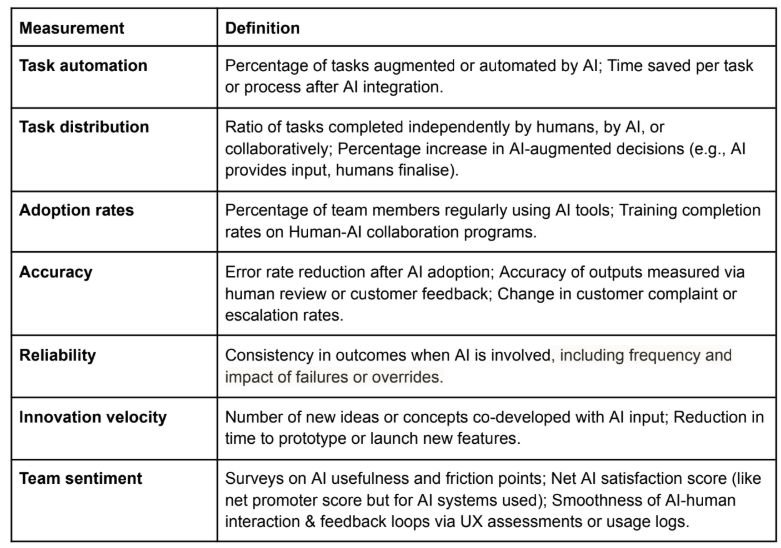
Progress can be benchmarked against internal goals and relevant industry standards. Sharing outcomes on a regular basis with team and organisational leaders reinforces the value of human-AI collaboration, builds momentum and can help identify where additional support, training or rethinking is needed.
Conclusion
The benefits of AI teammates, such as their autonomy, speed, and advanced pattern recognition, come along with real challenges, including blurred accountability, risk of over-reliance on the part of their human counterparts, and the potential to amplify existing biases. With agentic AI, systems act on goals rather than simply responding to prompts, so questions of control, coordination, and oversight become significantly more complex. These concerns don’t outweigh the potential of human-AI teams. Challenges and risks can be effectively addressed through responsible design choices, careful governance, thoughtful application, and disciplined everyday use. We are not passive recipients of AI technology but are its inventors, stewards, and active integrators, defining (and refining) how it should integrate into our work and our lives. At the team level, the opportunity is enormous, but the boundaries, roles, and responsibilities will need to be revisited and renegotiated just as they are in all-human teams. Organisations that deliberately implement AI, measure how it is used, and continuously optimise human-AI collaboration can unlock significantly more value than those that rely on ad hoc adoption. Ultimately, the question is not whether AI will join our teams, but how intentionally we choose to shape that partnership.
References
- Deloitte. (2026). The state of AI in the enterprise: The untapped edge. Deloitte. https://www.deloitte.com/us/en/what-we-do/capabilities/applied-artificial-intelligence/content/state- of-ai-in-the-enterprise.html
- Lynch, S. (2025, July 7). What workers really want from AI. Stanford Report. https://news.stanford.edu/stories/2025/07/what-workers-really-want-from-ai
- PwC. (2026, April 13). Want ROI from AI? Go for growth. PwC. https://www.pwc.com/gx/en/issues/technology/ai-performance/want-ai-roi-go-for-growth.html
- Jamillah Knowles & Digit / https://betterimagesofai.org / https://creativecommons.org/
licenses/by/4.0/