
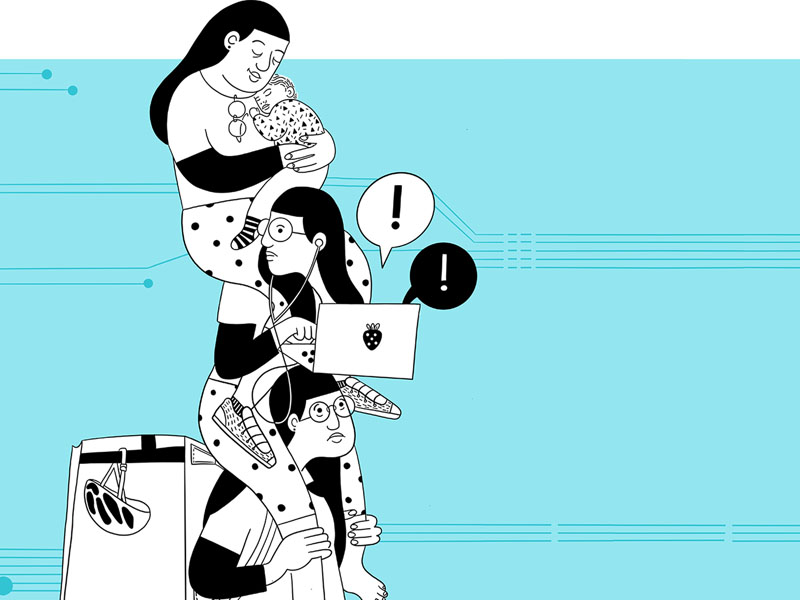
Feminist Perspectives: Forging Inclusive Narratives in Cybersecurity
Author Name
Mahera Sarkar
Published On
February 3, 2026
Keywords/Tags
Feminism; Digital Patriarchy; Algorithmic Bias; Cybercrime
Introduction
In the relentless battle against cybercrime, AI-powered cybersecurity has emerged as a critical tool, accelerating threat detection and decision-making.[1] Cybersecurity, broadly defined as the defence of digital spaces from unauthorised access, attacks, and damage, plays a crucial role, particularly in the UK, where there is one cybercrime victim every 37 seconds.[2] While it is widely acknowledged that women are often the primary targets of cybercrime,[3] a feminist perspective unveils a complex interplay between gender, power, and technology, reflecting and perpetuating historical and structural inequalities inherent in the physical world.[4] The impact of cybercrime is felt ubiquitously as the challenges women face online intricately connect to their offline experiences, forming a continuum of gender-based discrimination and vulnerability.[5] In this context, cybersecurity assumes an even simpler definition: how to deploy AI-driven tools to protect and empower women online.
To address this aim, this essay draws insights from two influential texts, ‘A Cyborg Manifesto’ by Donna Haraway and ‘The Second Sex’ by Simone de Beauvoir. Haraway’s concept of the cyborg as a symbol transcending traditional boundaries – be they related to gender, nature, or technology – encourages us to reconsider the traditional binaries that reinforce patriarchal epistemology.[6] Applied to women’s safety, this involves empowering women to navigate digital spaces as dynamic, resilient entities, breaking free from stereotypical victimhood. Beauvoir’s analysis of historical constructions of womanhood finds resonance in persisting biases in online interactions. Fixed categories imposed by personal security measures and AI algorithms reflect the rigid roles assigned to women in the past, restricting female autonomy and heightening vulnerability to cybercrime. Just as Beauvoir urges a re-evaluation of traditional gender norms, a parallel call to action is needed in the digital sphere to dismantle preconceived notions embedded in our technological systems. Integrating these feminist perspectives into cybersecurity discourse, this essay presents an original framework that acknowledges the unique vulnerabilities faced by women, thereby redefining the parameters of digital safety.
Dismantling Digital Patriarchy
The amalgamation of Haraway and Beauvoir’s perspectives offers a transformative lens for scrutinising entrenched masculine narratives in cybersecurity.[7] Beauvoir’s insights on womanhood reveal persistent historical constructs within the digital realm, while Haraway’s cyborg provides a revolutionary archetype for the abolition of sexual segregation.[8] This section explores conflicts between fluid identities and fixed gender roles, examining how AI-driven systems perpetuate biases and intersect with feminist critique.
In the digital sphere, where patriarchal structures persist, Beauvoir’s portrayal of the historical construction of womanhood remains relevant. The influence of gender dynamics in cybersecurity becomes apparent when considering her concept of “the drama of women”[9] – patriarchal limits that restrict women’s freedom.[10] Rooted in a male-dominated liberal order,[11] the digital landscape is shaped by masculine forces, granting them authority to regulate cybersecurity measures. This gendered influence permeates the design of protective tools,[12] reinforcing the perception of cybersecurity as “a man’s job”[13] and leading to exclusionary practises.[14] Militaristic language such as “warfare” and “combat” fuels this narrative, impacting not only public perception of cybersecurity but also its practical implementation.[15] This can lead to an overemphasis on offensive capabilities, such as the development of cyber weapons,[16] neglecting defensive measures essential for safeguarding critical structures and vulnerable populations. Within the realm of cybercrime, this has led to a distinct divergence emerging between men and women. Women, disproportionately impacted, express higher levels of emotional distress from incidents of online-based violence.[17] This gendered asymmetry is further accentuated by a female inclination to perceive existing policies and legislation as inadequate.[18] The underrepresentation of women in cybersecurity not only compounds the oversight and neglect of the unique challenges faced by female users but also highlights the role of AI in shaping these dynamics.[19] Unfairly burdening women with the responsibility of personal protection, this scarcity of representation exacerbates the digital gender divide,[20] where AI systems reinforce biases and add to the difficulties faced by women in digital spaces. The emergence of the ‘manosphere’, an online space championing male supremacy and misogyny,[21] serves as a tangible manifestation of digital exclusion. A HOPE Not Hate report demonstrated that 50% of men aged 16-24 believe feminism makes it more difficult for men to succeed,[22] thereby fuelling online gender violence. Despite women’s significant social and economic progress since ‘The Second Sex’, they continue to struggle against male-centric forces that reinforce a prevailing sense of targeting and alienation.[23] In the contemporary digital landscape, discriminatory hierarchies endure, preventing women from participating freely, safely, and authentically.[24]
Haraway’s introduction of the cyborg as a symbol that transcends traditional binaries, particularly those related to gender, disrupts established power structures, and encourages a re-evaluation of gender roles in digital spaces. This departure from rigid distinctions is significant in the context of prevailing social concepts of masculinity, which often fuel male cybercriminals’ entitlement to digitally dominate and control women.[25] Haraway’s term for this phenomenon, “feminisation”,[26] aptly encapsulates the systematic reduction of women to vulnerable, exploited objects of sexualisation in the digital landscape.[27] Throughout history, gender constructs have dictated power dynamics within familial and societal structures.[28] These imbalances have been transferred to the virtual networks of the internet, resulting in inadequate cybersecurity defences that fail to protect women.[29] Pervasive gender biases within the male-dominated cybersecurity industry impede the development of effective measures as a lack of diverse perspectives results in a failure to address the multifaceted nature of cybercrime. In challenging fixed identities, the cyborg offers a theoretical framework with practical implications for reshaping power dynamics and fostering a safer digital environment.
The conflict between Haraway’s emphasis on fluid identities and Beauvoir’s critique of fixed gender roles presents a complex intersection within the digital landscape. Beauvoir posits that becoming a woman involves a purposive and appropriative set of acts,[30] an idea transposed into the digital realm where identity construction becomes a deliberate act of self-definition.[31] In contrast, Haraway’s cyborg emphasises the fluidity of boundaries between human and machine, a notion based on the ability of technology to allow individuals to construct themselves away from stereotypes.[32] Reconciling these views within cybersecurity ethics can be achieved through their shared emphasis on intersectionality. Recognising the unique challenges faced by individuals at the intersections of race and gender is imperative for a comprehensive approach to personal cybersecurity.[33] Ethical considerations must transcend the limitations of a one-size-fits-all approach, acknowledging and addressing the diverse experiences of users in the digital realm.[34] This nuanced understanding of identity complexities is vital for dismantling digital patriarchy and fostering an online environment that promotes women’s safety.
The role of AI algorithms in perpetuating gender biases and stereotypes poses a critical challenge for successful cybersecurity measures. Meticulous design and training of these systems becomes imperative to prevent inadvertent reinforcement of existing patriarchal structures. One prominent example is the use of speech detection algorithms, which are heavily reliant on certain words as indicators of offensiveness.[35] Without adequate contextual information, biases can be propagated against certain groups.[36] This intersection of algorithmic bias and digital patriarchy is evident in instances of gendered cybercrime. Rather than being impartial conduits of information, these algorithms mirror historical stereotypes, entrenching systemic challenges for women navigating online spaces. The compounding effect of these biases is heightened by the internet’s empowering role,[37] providing essential information that can affect women’s physical health and bodily autonomy offline. In the face of these imbalances and the broader struggles faced by female users, there is a compelling case for recalibrating cybersecurity measures to put an end to digital patriarchy once and for all.
Cybersecurity as Empowerment: Rethinking Victimhood
Conventional cybersecurity narratives often draw on gender stereotypes to depict women as perpetual victims that must be protected at all costs.[38] By exploring Haraway’s cyborg as a symbol of empowerment and Beauvoir’s ideas on agency and freedom, this section dissects and analyses the tension between traditional ideas of female victimhood and the empowerment advocated for by both theorists. It concludes by discussing the potential of AI to reshape this discourse, emphasising its role in enhancing women’s digital literacy and providing tools for self-protection.
Beauvoir and Haraway’s perspectives enable us to oppose entrenched narratives of female victimhood. Rejecting a singular definition of womanhood, Beauvoir’s observation in 1949 that women “lack concrete means for organising themselves into a unit”[39] becomes an empowering statement, allowing for self-definition and identity fluidity. Women, unlike their male counterparts, are not emblematic of their sex but are labelled as “Other”,[40] meaning they can define themselves however they choose through emancipatory effort. Echoing this sentiment in 1985, Haraway asserts “there is nothing about being female that naturally binds women”[41] and rejects any “natural matrix of unity”.[42] By critiquing the limited fluidity within traditional feminist desires of a common language,[43] Haraway advocates for a dynamic understanding of femininity that repositions women as architects of cyberspace. Her exploration of “transgressed boundaries, potent fusions, and dangerous possibilities”[44] is interpreted here as a metaphorical representation of women breaking free from the confines of victimhood, no longer mere recipients of protection. Beauvoir’s infamous declaration that “one is not born, but rather, becomes a woman”[45] complements this paradigm shift and contests the idea of women being inherently vulnerable. Extending this agency to the digital realm, women are encouraged to actualise fluid identities and, rather than being relegated to the role of victims, become agents of their cybersecurity destinies.
However, a conflict arises between potential victimisation associated with entrenched societal roles and the avenues for liberation and fluid expression afforded by the digital sphere. Beauvoir views societal norms as constraints on gender freedom,[46] positioning women as victims. The inflexibility of societal expectations, dictating roles and identities, imposes limitations on agency and self-expression, perpetuating the hierarchical and binary dimensions of gender dynamics. In contrast, the virtual space disrupts gender functionality by negating physical manifestations and provides women with an opportunity to actualise fluid identities. Virtual spaces emerge as platforms for resistance against binary limitations inherent in heteropatriarchal ideologies and institutions,[47] serving as a medium for the re-evaluation of gender norms. This ethos is embodied by ‘A Cyborg Manifesto’, which posits that the internet enables women to virtually embody a self beyond the confines of the physical body and its sexed, gendered, racialised, and classed connotations.[48] Haraway states that “communication technologies and biotechnologies are the crucial tools for recrafting our bodies”[49], emphasising the emancipatory potential inherent in the digital domain. As technology intersects with gender dynamics, it serves as a conduit for social change, offering new paths for individuals to navigate, question, and reshape their identities in ways that defy traditional norms.
Beyond challenging entrenched notions of victimhood, integrating AI becomes crucial for empowering women in cybersecurity. The juxtaposition of Beauvoir’s aforementioned observation regarding women’s lack of collective strength with the potential of AI-driven solutions highlights a path towards empowerment. AI-based educational tools can be tailored to enhance women’s digital literacy, providing them with the skills necessary for informed participation in cybersecurity. Pollicy, an East African feminist collective, recently created an international fiction game dubbed Digital SafeTea, which presents scenarios for users to learn about existing and emerging digital safety issues and combat online violence.[50] By offering targeting learning experiences and hands-on training, these tools become instrumental in bridging knowledge gaps, empowering women to navigate and contribute to the complexities of the digital realm effectively. Moreover, AI-based solutions for threat detection and response hold the potential to revolutionise the narrative from victimhood to empowerment. Through leveraging machine learning algorithms capable of rapid analysis of vast datasets, these technologies enable quick identification and mitigation of potential threats.[51] The ability of AI to recognise patterns of harmful behaviour and intervene in real-time becomes a pivotal aspect of fostering a secure and inclusive digital experience across the internet. This proactive approach not only strengthens cybersecurity overall but also equips women with the tools to actively protect themselves online, disrupting traditional power dynamics. The emphasis here is not on creating a separate space for women but on supplying them with the tools to navigate the existing landscape on their terms.
Digital Challenges and Societal Norms
The intersection of prevailing societal norms and advanced technologies shape dynamics in surveillance, gatekeeping, and reputation within the digital realm. Influenced by ‘The Second Sex’ and ‘A Cyborg Manifesto’, this section explores gendered challenges in the digital realm, how they have been amplified by AI, and their effect on women’s autonomy.
Surveillance and Gendered Control
AI technologies integrated into digital surveillance are not impartial tools but instruments reinforcing gendered control. These systems, able to meticulously monitor and analyse human behaviour, play a pivotal role in perpetuating traditional power dynamics. A poignant example is the Iranian government’s use of AI-powered facial recognition in public transportation to monitor women’s adherence to strict hijab mandates.[52] This case illustrates how technology is weaponised to dictate women’s behaviour and choices, exacerbating existing societal oppressions. The incorporation of AI adds a new dimension to digital surveillance, transforming it into a tool for remotely reinforcing historical hierarchies that favour male dominance.[53] An alarming manifestation of this phenomenon occurred when South Asian governments deployed Pegasus spyware to silence female dissidents through unauthorised access to users’ personal texts, photographs and emails.[54] The contrast between Haraway’s critique of boundaries and the rigidity imposed by AI-driven surveillance practises underscores the inherent danger these technologies pose to women’s agency in online environments. Haraway’s term “the informatics of domination”[55] serves as a powerful reference to the masculinised techno-social world order, which is particularly threatening to women.[56] The application of her insights to this context reveals how AI, when used in surveillance, becomes a means of control, reinforcing patriarchal oppression and compromising the agency of women in the digital landscape.
Gatekeeping and Online Expression
Digital gatekeeping, comprising content moderation and censorship, has the ability to reflect and amplify societal norms. In practise, this often results in the prioritisation of cissexism and white femininities.[57] As AI becomes the primary arbiter of online content, it shapes and solidifies digital gatekeeping practises and can create an environment that limits women’s capacity for expression. This influence is particularly pronounced when viewed through a feminist lens, which reveals virtual platforms as sexist assemblages that repress female agency.[58] Social media community guidelines are developed in the sociocultural context of the educated, economically elite, politically libertarian, and racially monochromatic Silicon Valley.[59] As a result, the values, and rules they convey are not naturally supportive of women. The example of Tumblr’s 2018 ban on adult content, which explicitly prohibited images of “female-presenting nipples”,[60] aligns with Beauvoir’s criticism of men’s profiting “from the otherness, the alterity of women”.[61] This targeted restriction represents a contemporary manifestation of the historic male tendency to primarily perceive women as sexual beings highlighted in ‘The Second Sex’.[62] Social media companies’ propensity to oversexualise and problematise women, evidenced by such discriminatory policies, upholds a concerning precedent that the female body remains subject to societal scrutiny and control. These dynamics contribute to a digital environment where women encounter significant barriers to authentic expression, and are antithetical to the creation of safe online spaces.
Reputation and Gendered Digital Perceptions
In the internet era, one’s reputation, moulded by behaviour,[63] wields significant power over personal and professional opportunities. This influence transcends face-to-face interaction into the virtual sphere where online activities shape digital identities. The rise of cyberrape, or ‘revenge porn’, demonstrates the unique vulnerabilities women face in a digitally interconnected world. This cybercrime, which disproportionately impacts women,[64] involves the non-consensual dissemination of intimate images.[65] A notable case involved the actress Bella Thorne, who released nude images in response to threats of non-consensual exposure and was widely criticised for doing so.[66] This example illustrates the continued coercion of women into the male gaze,[67] and their struggle to reclaim control over digital narratives. Yet, such acts expose women to judgement and ostracisation due to gendered and heteronormative dynamics that govern sexual image-sharing.[68] AI-driven deepfake technology intensifies these norms, enabling cybercriminals to fabricate and distribute sexually explicit content.[69] According to a 2019 report, 96% of deepfake material is of a pornographic nature, underscoring the pervasive nature of this issue.[70] This misuse of AI not only violates privacy but also fuels detrimental gendered perceptions, impacting women offline. As new methods emerge for the exploitation of women, the interplay between their digital presence and reputations reveals an alarming reality. Technological progress heightens the difficulties women face in safeguarding their online image and reinforces the profound repercussions of exploitation.
Towards Inclusive Cybersecurity: Redefining Safety Parameters
With the aim of forging inclusive narratives in cybersecurity, this section proposes a paradigm shift in safety parameters. This redefinition involves prioritising inclusive design principles within cybersecurity and aspires to accommodate diverse user needs. Inspired by Beauvoir and Haraway’s feminist principles, it advocates for a narrative-centric approach to cybersecurity education that utilises storytelling. This not only challenges stereotypes but also enables women to navigate online spaces securely. The integration of AI-driven systems goes beyond enhancing digital literacy; it actively shapes safety standards online. In the protection of vulnerable communities, AI assumes a pivotal role, harmonising conflicts between individual agency and collective strength, thereby fortifying the digital realm.
Narrative-Centric Cybersecurity Education
Effective cybersecurity relies on clear communication, and the use of storytelling as a medium offers a comprehensible way to convey complex information.[71] Given that most cybersecurity resources are laden with dense jargon, the issue at hand is the scarcity of accessible materials tailored specifically for women.[72] Adopting a feminist lens, this narrative-centric approach involves crafting stories that not only deconstruct power imbalances and challenge stereotypes but also empower individuals to critically evaluate their understanding of online spaces. By addressing the prevailing information asymmetry that marginalises women in cybersecurity discussions,[73] narrative-centric cybersecurity education aims to cultivate an inclusive environment that recognises and protects all individuals. Its use of human-centric storylines and progressive structure enables users to connect and remember key messages.[74] AI can further enhance educational tools by providing real-time adaptive scenarios and simulating authentic cybersecurity attacks tailored to users’ needs.[75] This dynamic strategy equips participants with tangible skills, enabling them to successfully confront and mitigate online threats. However, navigating potential conflicts in this model requires a delicate balances between feminist principles and the boundary-transcending nature of the cyborg, which emphasises the malleability of digital identities.[76] Establishing an educational framework that acknowledges the fluidity of individual experiences and perspectives is vital. The narratives crafted through this lens become a transformative force, fostering inclusivity, critical awareness, and resilience. Crucially, they ensure that safety parameters are not rigid constructs but adaptive elements that evolve organically with the diverse stories encountered in the digital realm, thereby promoting women’s safety online.
Inclusive Design in Cybersecurity Tools
To ensure women’s safety online, cybersecurity tools must prioritise gender mainstreaming, an inherently intersectional concept that recognises the diversity of technology users in their identities and needs.[77] This approach is especially attentive to the ways in which other forms of social power work alongside gender to produce patterns of marginalisation and exclusion.[78] By adopting gender mainstreaming, cybersecurity tools not only directly address women’s safety concerns but also contribute to a broader societal commitment to inclusivity, accommodating users across various dimensions of identity and experience.[79] The integration of AI-driven tools in this context becomes particularly significant. Through their analysis of user behaviour and preferences, these systems can play a central role in the ongoing redefinition of safety standards, fostering a more user-friendly online environment.[80]. This was seen in practise with CrowdStrikeFalcon, an AI-powered cybersecurity platform, which helped investigate the Democratic National Committee cyberattacks and their connection to Russian intelligence services.[81] The synergy between gender mainstreaming and AI-powered cybersecurity tools marks a notable shift in improving online safety, going beyond the capabilities of universally applicable cybersecurity models to address the multifaceted needs of users. Haraway’s call for the breaking down of dualisms and traditional categories adds a powerful dimension to this perspective,[82] creating a more expansive view of safety within technological solutions. When integrated into cybersecurity, this view ensures protective measures are attuned to the diverse contexts in which they operate, establishing a democratic and equitable approach to safety considerations. The call for inclusive design in cybersecurity tools is not merely a technological imperative but a means of reshaping digital spaces for the benefit of all users. This collective effort, rooted in inclusivity and adaptability, is essential for creating a digital landscape that truly protects women.
Empowering Vulnerable Communities
The urgent need to redefine safety parameters becomes most apparent when considering female survivors of cybercrime and those most at risk. Having established that women are disproportionately affected by cybercrime and experience heightened vulnerability in the virtual realm,[83] it is essential to incorporate feminist principles into the development of AI initiatives and support networks. This approach seeks to rectify historical exclusions and the silencing of women in digital spaces, providing them with both technological safeguards and an inclusive online environment. By leveraging AI-driven resources, personalised solutions can be created to address the specific challenges faced by women online.[84] Successful examples include the AI-powered eMonitor+ tool, used in Libya to identify geographic trends in online violence against women during elections and deploy automated fact-checking.[85] Similarly, the Sara chatbot, operating in Central America, offers continuous free information and guidance to victims or women at risk of violence.[86] The combination of technological innovation and feminist ideals seeks to move beyond generic approaches to online safety, dismantling systemic gender inequalities in the digital sphere. However, in the pursuit of this objective, it is necessary to reconcile the need to uplift individual voices with the collective strength facilitated by AI. Whilst Beauvoir advocates for individual autonomy, Haraway’s merging of human and machine promotes a balance that respects both personal agency and community resilience. In successfully navigating this equilibrium, AI-driven initiatives can redefine safety standards in the digital realm, ensuring the safety and empowerment of those who need it most.
Conclusion
Incorporating Beauvoir and Haraway’s feminist perspectives into contemporary cybersecurity discourse provides transformative insights and solutions for addressing gendered challenges in digital spaces. The rise of the ‘manosphere’ and persistent gender disparities in the cybersecurity industry underscore the need for representation and diverse perspectives in bridging the digital gender gap.[87] This essay advocates for the empowerment of women in cybersecurity, rejecting victimhood and illustrating the importance of self-protection and digital literacy. Tangible steps such as narrative-centric cybersecurity education and inclusive design in cybersecurity tools are outlined for achieving this goal. This comprehensive approach, blending feminist ideals with technological innovation, calls for a redefinition of safety parameters and aims to dismantle systemic gender inequalities in the virtual sphere. As the fight against cybercrime continues, adopting the feminist frameworks outlined in this essay becomes imperative, reshaping the trajectory of cybersecurity and AI ethics for the collective benefit of all users.
BIBLIOGRAPHY
- Ahmad, Nour (2019) ‘We Are All Cyborgs: How Machines Can Be a Feminist Tool’, IMS.
- Aiston, Jessica (2021) ‘What Is the Manosphere and Why Is It a Concern?’, Internet Matters.
- Ariganello, Joe (2023) ‘Unveiling the Power of AI: Revolutionizing Threat Detection, Investigation, and Response’, Mix Mode.
- Barrinha, André and Renard, Thomas (2020) ‘Power and Diplomacy in the Post-Liberal Cyberspace’, International Affairs, 96(3), p. 750.
- Beauvoir, Simone de (1953) The Second Sex. Translated by Howard Maddison Parshley, p. 16, p. 18, p. 24, p. 27, p. 273.
- Bias in Algorithms – Artificial Intelligence and Discrimination (2022). European Union Agency for Fundamental Rights.
- Brooks, Chuck (2023) ‘A Primer On Artificial Intelligence And Cybersecurity’, Forbes.
- Brown, Deborah and Pytlak, Alison (2020) Why Gender Matters in International Cyber Security, p. 2, p. 3, p. 6, p. 7, p. 19.
- Burns, Janet (2018) ‘Tumblr Announces Adult Content Ban Starting Mid-December’, Forbes.
- Butler, Judith (1986) ‘Sex and Gender in Simone de Beauvoir’s Second Sex’, Yale French Studies, (72), p. 36, p. 41.
- Chandok, Kashvi (2021) ‘No Safe Space For Women: The Rise in Digital Surveillance in South Asia’, LSE Department of Gender Studies.
- Da Silva, Joseph (2023) ‘Protection, Expertise and Domination: Cyber Masculinity In Practice’, Computers & Security, 133.
- Davis Kempton, Stefanie (2020) ‘Erotic Extortion: Understanding the Cultural Propagation of Revenge Porn’, SAGE Open, 10(2).
- Delfino, Rebecca (2023) ‘Revenge Porn, Deep Fakes, AI’, Boston University Law School.
- Doran, Kerry (2018) ‘Contextualizing the Cyborg’, Open Space.
- Donegan, Moira (2023) ‘Demand for Deepfake Pornography Is Exploding. We Aren’t Ready for This Assault on Consent’, The Guardian.
- Dunn, Suzie et al. (2023) Supporting Safer Digital Spaces. Centre for International Governance Innovation.
- Duggan, Maeve (2017) ‘Men and Women Experience and View Online Harassment Differently’, Pew Research Centre.
- Emerson-Keeler, Rebecca et al. (2023) Integrating Gender in Cybercrime Capacity-Building. Chatham House.
- Flynn, Asher et al. (2023) ‘Victim-Blaming and Image-Based Sexual Abuse’, Journal of Criminology, 56(1), p. 16.
- Gawn, Anna (2023) ‘What Has Cybersecurity Got to Do with Gender Equality and Social Inclusion?’, Social Development Direct.
- Gerrard, Ysabel and Thornham, Helen (2020) ‘Content Moderation: Social Media’s Sexist Assemblages’, New Media & Society, 22(7), p. 1269.
- Griffin, Charles (2024) ‘The Latest Cybercrime Statistics’, AAG.
- Haraway, Donna Jeanne (2016) ‘A Cyborg Manifesto’, in Manifestly Haraway. University of Minnesota Press, p. 16, p. 21, p. 28, p. 33, p. 38, p. 52, p. 59.
- Hofstetter, Juliana-Silvana and Pourmalek, Panthea (2023) ‘Gendering Cybersecurity through Women, Peace and Security: Gender and Human Rights in National-level Approaches to Cybersecurity’, ICT4Peace Foundation.
- Jereza, Rae (2022) ‘The Cissexist Assemblages of Content Moderation’, GNET.
- Jewkes, Rachel et al. (2015) ‘Hegemonic Masculinity: Combining Theory and Practice in Gender Interventions’, Culture, Health & Sexuality, 17(sup2), p. 121.
- Khan, Rose (2022) ‘Media (Mis)Representation of Conflict-Related Sexual Violence’, Media@LSE.
- Koigi, Bob (2022) ‘Digital SafeTea: Protecting the Safety of Women Online’, FairPlanet.
- Kaur, Ramanpreet et al. (2023) ‘Artificial Intelligence for Cybersecurity: Literature Review and Future Research Directions’, Information Fusion, 97.
- Kumari, Meena (2023) ‘Harnessing the Power of AI in the Violence Against Women and Girls’, H.O.P.E Training & Consultancy.
- Langley, Harvey (2023) ‘Freedom and Agency in The Second Sex’, European Journal of Philosophy.
- Levy Daniel, Maria (2023) ‘APC Policy Explainer: What Is a Gender Approach to Cybersecurity?’, Association for Progressive Communications.
- Liu-Rosenbaum, Aaron (2018) ‘Weaving “Eroticism, Cosmology, and Politics” in Early Female Technopop: Three Discourses with the Informatics of Domination’, Popular Music and Society, 41(1), p. 16.
- Mangumbu, Connie (2019) ‘Bella Thorne Reclaims Her Own Nudes: Sexualization, Agency & the Issue with Clout’, Hunger.
- McCullough, Steve (2023) ‘Online Misogyny: The “Manosphere”’, The Canadian Museum of Human Rights.
- McKinlay, Tahlee and Lavis, Tiffany (2020) ‘Why Did She Send It in the First Place? Victim Blame in the Context of “Revenge Porn”’, Psychiatry, Psychology, and Law, 27(3).
- Millar, Katharine (2022) ‘What Does it Mean to Gender Mainstream the Proposed Cybercrime Convention?’ Chatham House.
- Namakula, Patricia (2023) ‘Power Dynamics and How They Facilitate Online Gender-Based Violence’, Centre for Multilateral Affairs.
- Objenike, Tobi (2023) ‘How AI Can Actually Help Designers, Not Harm Them’, Venngage.
- Peacock, Donna and Irons, Alistair (2017) ‘Gender Inequality in Cybersecurity: Exploring the Gender Gap in Opportunities and Progression’, International Journal of Gender, Science and Technology, 9(1), p. 25.
- Post, Emily and Macfarlan, Shane (2020) ‘Tracking Cross-Cultural Gender Bias in Reputations’, Cross-Cultural Research, 54(4), p. 347.
- Roberts, Sarah (2019) Behind the Screen: Content Moderation in the Shadows of Social Media. 1st edn. New Haven: Yale University Press, p. 93.
- Saboya, Maria Beatriz (2023) ‘Surveillance, Identity, and Gender: Navigating the AI-Driven Digital Age’, The Digital Constitutionalist.
- Sharratt, Elena (2019) Intimate Image Abuse in Adults and Under 18s. University of Exeter.
- Stark, Luke et al. (2020) ‘“I Don’t Want Someone to Watch Me While I’m Working”: Gendered Views of Facial Recognition Technology in Workplace Surveillance’, Journal of the Association for Information Science and Technology, 71(9), p. 1074.
- Tolliver, Nicholas (2022) ‘Cyborg Liberation: Donna Haraway’s Cyborg Feminism as an Emancipatory Model of Identity’, Columbia Social Work Review, 20(1), p. 135, p. 137.
- ‘The Art of Storytelling’ (2023) Vajra Global.
- Vogels, Emily et al. (2020) ‘Power Dynamics Play a Key Role in Problems and Innovation’, Pew Research Centre: Internet, Science & Tech.
- [1] Brooks, Chuck (2023) ‘A Primer On Artificial Intelligence And Cybersecurity’, Forbes.
- [2] Griffin, Charles (2024) ‘The Latest Cybercrime Statistics’, AAG.
- [3] Hofstetter, Juliana-Silvana and Pourmalek, Panthea (2023) ‘Gendering Cybersecurity through Women, Peace and Security: Gender and Human Rights in National-level Approaches to Cybersecurity’, ICT4Peace Foundation.
- [4] Brown, Deborah and Pytlak, Alison (2020) Why Gender Matters in International Cyber Security, p. 2.
- [5] Brown, Deborah and Pytlak, Alison (2020) Why Gender Matters in International Cyber Security, p. 6.
- [6] Ahmad, Nour (2019) ‘We Are All Cyborgs: How Machines Can Be a Feminist Tool’, IMS.
- [7] Da Silva, Joseph (2023) ‘Protection, Expertise and Domination: Cyber Masculinity In Practice’, Computers & Security, 133, p. 103408.
- [8] Ibid.
- [9] Beauvoir, Simone de (1953) The Second Sex. Translated by Howard Maddison Parshley, p. 27.
- [10] Langley, Harvey (2023) ‘Freedom and Agency in The Second Sex’, European Journal of Philosophy.
- [11] Barrinha, André and Renard, Thomas (2020) ‘Power and Diplomacy in the Post-Liberal Cyberspace’, International Affairs, 96(3), p. 750.
- [12] Gawn, Anna (2023) ‘What Has Cybersecurity Got to Do with Gender Equality and Social Inclusion?’, Social Development Direct.
- [13] Peacock, Donna and Irons, Alistair (2017) ‘Gender Inequality in Cybersecurity: Exploring the Gender Gap in Opportunities and Progression’, International Journal of Gender, Science and Technology, 9(1), p. 25.
- [14] Da Silva, Joseph (2023) ‘Protection, Expertise and Domination: Cyber Masculinity In Practice’, Computers & Security, 133, p. 103408.
- [15] Ibid.
- [16] Byerley, Steve (2023) ‘Global Cyber Weapon Market To See Significant Growth’, Insurance Business..
- [17] Duggan, Maeve (2017) ‘Men and Women Experience and View Online Harassment Differently’, Pew Research Centre.
- [18] Ibid.
- [19] Vogels, Emily et al. (2020) ‘Power Dynamics Play a Key Role in Problems and Innovation’, Pew Research Centre: Internet, Science & Tech.
- [20] Namakula, Patricia (2023) ‘Power Dynamics and How They Facilitate Online Gender-Based Violence’, Centre for Multilateral Affairs.
- [21] McCullough, Steve (2023) ‘Online Misogyny: The “Manosphere”’, The Canadian Museum of Human Rights.
- [22] Aiston, Jessica (2021) ‘What Is the Manosphere and Why Is It a Concern?’, Internet Matters.
- [23] Brown, Deborah and Pytlak, Alison (2020) Why Gender Matters in International Cyber Security, p. 19.
- [24] Dunn, Suzie et al. (2023) Supporting Safer Digital Spaces. Centre for International Governance Innovation.
- [25] Jewkes, Rachel et al. (2015) ‘Hegemonic Masculinity: Combining Theory and Practice in Gender Interventions’, Culture, Health & Sexuality, 17(sup2), p. 121.
- [26] Haraway, Donna Jeanne (2016) ‘A Cyborg Manifesto’, in Manifestly Haraway. University of Minnesota Press, p. 48.
- [27] Ibid, p. 38.
- [28] Brown, Deborah and Pytlak, Alison (2020) Why Gender Matters in International Cyber Security, p. 3.
- [29] Doran, Kerry (2018) ‘Contextualizing the Cyborg’, Open Space.
- [30] Butler, Judith (1986) ‘Sex and Gender in Simone de Beauvoir’s Second Sex’, Yale French Studies, (72), p. 36.
- [31] Buckingham, David (2008) Youth, Identity, and Digital Media, MIT Press.
- [32] Ahmad, Nour (2019) ‘We Are All Cyborgs: How Machines Can Be a Feminist Tool’, IMS.
- [33] Levy Daniel, Maria (2023) ‘APC Policy Explainer: What Is a Gender Approach to Cybersecurity?’, Association for Progressive Communications.
- [34] Gawn, Anna (2023) ‘What Has Cybersecurity Got to Do with Gender Equality and Social Inclusion?’, Social Development Direct.
- [35] Bias in Algorithms – Artificial Intelligence and Discrimination (2022). European Union Agency for Fundamental Rights.
- [36] Ibid.
- [37] Brown, Deborah and Pytlak, Alison (2020) Why Gender Matters in International Cybersecurity, p. 7.
- [38] Khan, Rose (2022) ‘Media (Mis)Representation of Conflicted-Related Sexual Violence’, Media@LSE.
- [39] Beauvoir, Simone de (1953) The Second Sex. Translated by Howard Maddison Parshley, p. 18.
- [40] Ibid, p. 16
- [41] Haraway, Donna Jeanne (2016) ‘A Cyborg Manifesto’, in Manifestly Haraway. University of Minnesota Press, p. 16.
- [42] Ibid, p. 21.
- [43] Ibid, p. 52.
- [44] Ibid.
- [45] Beauvoir, Simone de (1953) The Second Sex. Translated by Howard Maddison Parshley, p. 273.
- [46] Butler, Judith (1986) ‘Sex and Gender in Simone de Beauvoir’s Second Sex’, Yale French Studies, (72), p. 41.
- [47] Tolliver, Nicholas (2022) ‘Donna Haraway’s Cyborg Feminism as an Emancipatory Model of Identity’, Columbia Social Work Review, 20(1), p. 135.
- [48] Doran, Kerry (2018) ‘Contextualizing the Cyborg’, Open Space.
- [49] Haraway, Donna Jeanne (2016) ‘A Cyborg Manifesto’, in Manifestly Haraway. University of Minnesota Press, p. 33.
- [50] Koigi, Bob (2022) ‘Digital SafeTea: Protecting the Safety of Women Online’, FairPlanet.
- [51] Ariganello, Joe (2023) ‘Unveiling the Power of AI: Revolutionizing Threat Detection, Investigation, and Response’, Mix Mode.
- [52] Saboya, Maria Beatriz (2023) ‘Surveillance, Identity, and Gender: Navigating the AI-Driven Digital Age’, The Digital Constitutionalist.
- [53] Stark, Luke et al. (2020) ‘“I Don’t Want Someone to Watch Me While I’m Working”: Gendered Views of Facial Recognition Technology in Workplace Surveillance’, Journal of the Association for Information Science and Technology, 71(9), p. 1074.
- [54] Chandok, Kashvi (2021) ‘No Safe Space For Women: The Rise in Digital Surveillance in South Asia’, LSE Department of Gender Studies.
- [55] Haraway, Donna Jeanne (2016) ‘A Cyborg Manifesto’, in Manifestly Haraway. University of Minnesota Press, p. 28.
- [56] Liu-Rosenbaum, Aaron (2018) ‘Weaving “Eroticism, Cosmology, and Politics” in Early Female Technopop: Three Discourses with the Informatics of Domination’, Popular Music and Society, 41(1), p. 16.
- [57] Jereza, Rae (2022) ‘The Cissexist Assemblages of Content Moderation’, GNET.
- [58] Gerrard, Ysabel and Thornham, Helen (2020) ‘Content Moderation: Social Media’s Sexist Assemblages’, New Media & Society, 22(7), p. 1269.
- [59] Roberts, Sarah (2019) Behind the Screen: Content Moderation in the Shadows of Social Media. 1st edn. New Haven: Yale University Press, p. 93.
- [60] Burns, Janet (2018) ‘Tumblr Announces Adult Content Ban Starting Mid-December’, Forbes.
- [61] Beauvoir, Simone de (1953) The Second Sex. Translated by Howard Maddison Parshley, p. 24.
- [62] Ibid, p. 16.
- [63] Post, Emily and Macfarlan, Shane (2020) ‘Tracking Cross-Cultural Gender Bias in Reputations’, Cross-Cultural Research, 54(4), p. 347.
- [64] Sharratt, Elena (2019) Intimate Image Abuse in Adults and Under 18s. University of Exeter.
- [65] Mckinlay, Tahlee and Lavis, Tiffany (2020) ‘Why Did She Send It in the First Place? Victim Blame in the Context of “Revenge Porn”’, Psychiatry, Psychology, and Law, 27(3), p. 386.
- [66] Mangumbu, Connie (2019) ‘Bella Thorne Reclaims Her Own Nudes: Sexualisation, Agency & the Issue with Clout’, Hunger.
- [67] Davis Kempton, Stefanie (2020) ‘Erotic Extortion: Understanding the Cultural Propagation of Revenge Porn’, SAGE Open, 10(2).
- [68] Flynn, Asher et al. (2023) ‘Victim-Blaming and Image-Based Sexual Abuse’, Journal of Criminology, 56(1), p. 16.
- [69] Delfino, Rebecca (2023) ‘Revenge Porn, Deep Fakes, AI’, Boston University Law School.
- [70] Donegan, Moira (2023) ‘Demand for Deepfake Pornography Is Exploding. We Aren’t Ready for This Assault on Consent’, The Guardian.
- [71] ‘The Art of Storytelling’ (2023) Vajra Global.
- [72] Koigi, Bob (2022) ‘Digital SafeTea: Protecting the Safety of Women Online’, FairPlanet.
- [73] Millar, Katharine (2022) ‘What Does it Mean to Gender Mainstream the Proposed Cybercrime Convention?’ Chatham House.
- [74] ‘The Art of Storytelling’ (2023) Vajra Global.
- [75] Kaur, Ramanpreet et al. (2023) ‘Artificial Intelligence for Cybersecurity: Literature Review and Future Research Directions’, Information Fusion, 97, p. 101804.
- [76] Tolliver, Nicholas (2022) ‘Cyborg Liberation: Donna Haraway’s Cyborg Feminism as an Emancipatory Model of Identity’, Columbia Social Work Review, 20(1), p. 137.
- [77] Gawn, Anna (2023) ‘What Has Cybersecurity Got to Do with Gender Equality and Social Inclusion?’, Social Development Direct.
- [78] Millar, Katharine (2022) ‘What Does it Mean to Gender Mainstream the Proposed Cybercrime Convention?’ Chatham House.
- [79] Emerson-Keeler, Rebecca et al. (2023) Integrating Gender in Cybercrime Capacity-Building. Chatham House.
- [80] Objenike, Tobi (2023) ‘How AI Can Actually Help Designers, Not Harm Them’, Venngage.
- [81] The Washington Post (2017) ‘Full Transcript: FBI Director James Comey Testifies on Russian Interference in 2016 Election’.
- [82] Haraway, Donna Jeanne (2016) ‘A Cyborg Manifesto’, in Manifestly Haraway. University of Minnesota Press, p. 59.
- [83] Duggan, Maeve (2017) ‘Men and Women Experience and View Online Harassment Differently’, Pew Research Centre.
- [84] Kumari, Meena (2023) ‘Harnessing the Power of AI in the Violence Against Women and Girls’, H.O.P.E Training & Consultancy.
- [85] Zuroski, Nick (2023) ‘Weapon or Tool?: How the Tech Community Can Shape Robust Standards and Norms for AI, Gender, and Peacebuilding’, GNET.
- [86] Ibid.
- [87] Aiston, Jessica (2021) ‘What Is the Manosphere and Why Is It a Concern?’, Internet Matters.
Julieta Longo & Digit / https://betterimagesofai.org / https://creativecommons.org/